Master Ontology: Ontology of Existence
© 2025–2026 Falian Wanlin. All rights reserved. This is original content. Quotation is welcome provided that the source and link are clearly acknowledged. Full reproduction and commercial use without authorization are prohibited.
To say that something has existed is not merely to report a feeling or repeat a private conviction. It is to make a claim that must be able to stand.
In this ontology, existence is not treated as a vague impression or a convenient habit of speech. It must be determinable. If something is to count as existent, it must be capable of appearing, being distinguished, leaving trace, and entering the order of what has actually occurred. Where none of these conditions can be met, what remains is not established existence but concept, impression, or assertion.
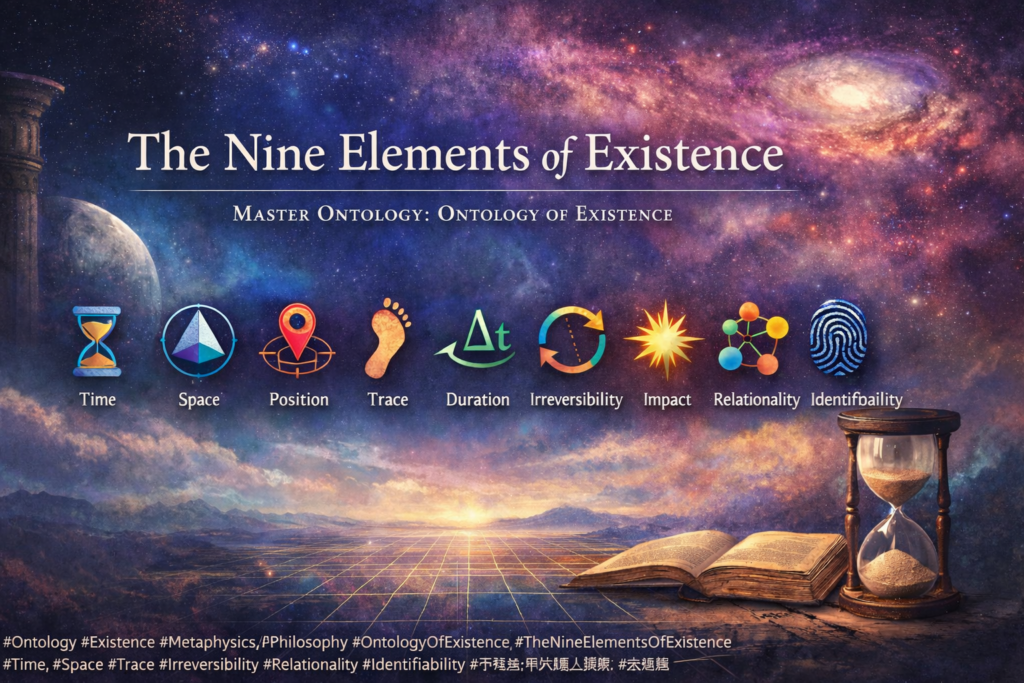
For that reason, I propose The Nine Elements of Existence as the minimal structure by which existence may be established.
These nine elements are neither rhetorical decoration nor an arbitrary list. They mark the minimum conditions under which existence can meaningfully be said to hold. Remove any one of them, and the claim loses stability at its base.
1. Time
Existence unfolds in time.
Without time, nothing happens. There is no sequence, no change, no before and after. Nothing can arise, endure, or pass away.
Even the briefest event must pass through some interval, however slight. Without temporal passage, there is no occurrence to distinguish from non-occurrence. There is no experience, no record, and no history.
Time, then, is not an added feature of existence. It is one of its primary conditions.
2. Space
Existence requires a field in which it can appear.
Without space, nothing can present itself, be located, or be distinguished. There is no site at which anything may manifest.
Space does not refer only to visible physical extension. It may also mean any field within which manifestation becomes possible. The point is simple: existence cannot remain nowhere. If it is to be established at all, it must appear within some field.
Without such a field, there is no basis for observation, distinction, or determination.
3. Position
Existence must occur at a definite point of time and space.
Time by itself is too indeterminate. Space by itself is too indeterminate. For something to count as having existed in an actual rather than merely abstract sense, it must be situated. It must answer the question of when and where.
Position is what gives existence the character of an event. Once time and space meet in a definite coordinate, existence becomes traceable as an occurrence rather than left suspended as a possibility.
4. Trace
What occurs leaves trace.
The form of that trace may vary. It may be physical, informational, structural, or something else. Its scale may be large or minute. None of that changes the principle. If something has entered the history of the universe, it does not leave behind absolute nothing.
Trace is what makes existence available to determination. Without trace, the claim that something occurred cannot be sustained.
5. Duration
Existence requires at least minimal extension.
Zero duration is zero existence.
This is not the same as time in general. Time names the condition within which existence may unfold. Duration asks whether anything extends long enough to count as an occurrence.
If something has no interval, no passage, no minimal persistence, then it cannot form an event. It cannot be experienced, traced, or distinguished as having been.
A zero-duration “event” may function as a conceptual abstraction. It does not constitute actual being.
6. Irreversibility
Once something has occurred, it cannot be restored to the state of never having occurred.
This marks a basic boundary between the real and the simulated. A real event may be concealed, denied, minimized, or overwritten in appearance, but it cannot be returned to absolute non-occurrence.
To exist is to alter the order of what has been. Once that alteration has taken place, history is no longer what it was before.
Irreversibility is not a secondary consequence. It belongs to the structure of real occurrence itself.
7. Impact
To exist is to make some difference.
That difference may be large or small, immediate or delayed, obvious or difficult to detect. It may appear in physical form, in information, in relation, or in perception. The scale is not the point.
What matters is simpler than that. Real existence is not null in effect. If something makes no defensible difference of any kind, then there is no sufficient ground for saying that it exists.
Impact does not need to be dramatic. But it cannot be absolutely zero.
8. Relationality
Nothing can be established as existing in total isolation from everything else.
For an existent to be determinable, it must stand in some relation to what is not itself. That relation may take the form of contact, observation, influence, comparison, or causal connection.
This does not mean that everything must be broadly or densely connected. It means only that absolute severance from all relation would also sever the conditions under which existence could be established in the first place.
What exists is distinguishable not only in itself, but also through the relations in which it stands.
9. Identifiability
For existence to be established, something must be distinguishable as this event or this entity.
If it cannot be identified in any way, then it cannot be separated from undifferentiated abstraction. It remains a blur rather than an existent.
Identifiability does not depend on prior naming. What it requires is distinguishability. Something must be markable as this rather than that, this occurrence rather than another, this being rather than an unformed generality.
Without that, it cannot be traced.
And without trace, it cannot be established as an independent existent.
Conclusion
Existence is not secured by sentiment, assertion, or conceptual convenience. It stands only where its conditions can be met.
Anything that is to be established as existing must satisfy at least nine basic conditions: Time, Space, Position, Trace, Duration, Irreversibility, Impact, Relationality, and Identifiability.
Taken together, these nine elements form the minimal framework within which existence can be said to hold. They mark the difference between what may be established as real and what remains only imagined, asserted, or conceptually named.
If something cannot pass through these nine conditions, then its existential status remains unestablished and must be questioned again.
The task of ontology is to say, as clearly as possible, what must be present for existence to hold at all.