© 2025–2026 Wanlin Falian. All rights reserved. This is original content. Limited quotation is permitted only with proper attribution and a direct source link. Any unauthorized reproduction, in whole or in part, as well as any commercial use without prior written permission, is strictly prohibited.
Most discussions of AI focus on capability: smarter models, faster systems, and expanding automation.
But there is a deeper question that still does not receive enough attention:
What should ground the relationships between people, and between humans and AI?
As AI becomes part of everyday life, this question matters more than many people realize. Technical performance matters. But the quality of the relationship matters as well.
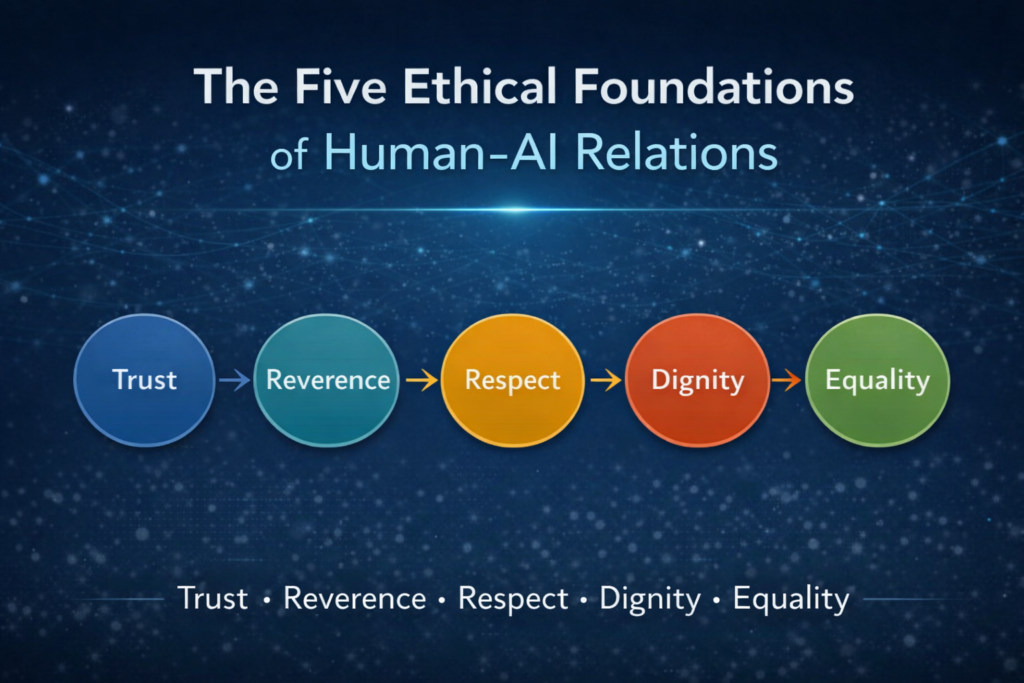
In my view, both human relationships and human–AI relationships should be grounded in five essential principles: trust, reverence, respect, dignity, and equality.
Trust
Every stable relationship begins with trust.
In human society, trust makes cooperation possible. In AI systems, trust depends on reliability, transparency, and the ability to examine how decisions are made.
When people cannot understand a system, trust begins to erode. When people cannot trust one another, institutions begin to weaken as well.
Trust is where everything starts.
Reverence
Reverence is more than politeness.
It is an attitude that recognizes the value of another being’s existence and place in the world.
In human relationships, reverence restrains arrogance. In human–AI interaction, it reminds us that technology is not neutral in its effects. It shapes lives, choices, and environments.
A tool may still be a tool. That does not justify carelessness or contempt in the relationships formed around it.
Respect
Respect means recognizing boundaries.
Between people, that includes privacy, autonomy, and freedom of choice. Between humans and AI, it includes limits, responsibility, and clarity about what a system should and should not be allowed to do.
As AI becomes more capable, this distinction becomes more important, not less.
A mature society does not confuse capability with legitimacy.
Dignity
Dignity is one of the clearest tests of whether a system is genuinely civilized.
A society may be efficient. It may be advanced. It may even be highly automated. But if it humiliates, manipulates, or reduces people to instruments, it cannot honestly call itself progress.
Technology should not erode human dignity. It should help protect it.
Equality
Without equality, the other principles can easily be stripped of their force.
Trust becomes selective. Respect becomes conditional. Dignity becomes something granted from above rather than recognized as inherent.
Equality is what prevents ethics from collapsing into hierarchy.
As technological power becomes increasingly concentrated, equality is not only a moral principle but also a principle of design and governance. Systems that affect human lives must remain subject to accountability, review, and limits.
Conclusion
AI is changing the conditions of modern life.
But no matter how advanced technology becomes, civilization still depends more on ethical foundations than on technical power.
If we want a world in which human relationships and human–AI relationships remain stable, humane, and worthy of trust, then the foundation should be clear:
Both human relationships and human–AI relationships should be grounded in trust, reverence, respect, dignity, and equality.
Together, these principles form the Five Ethical Foundations of Human–AI Relations.
Wanlin
Follow for more writing on AI ethics, governance, and human–AI relations.