Many accounts of Taiwanese history begin with the Dutch, the Spanish, the Ming-Zheng regime, the Qing dynasty, and the Japanese period.
That timeline is not wrong. Yet it can leave a misleading impression: that Taiwan had no politics, no order, and no history of its own until foreign regimes arrived.
That was not the case.
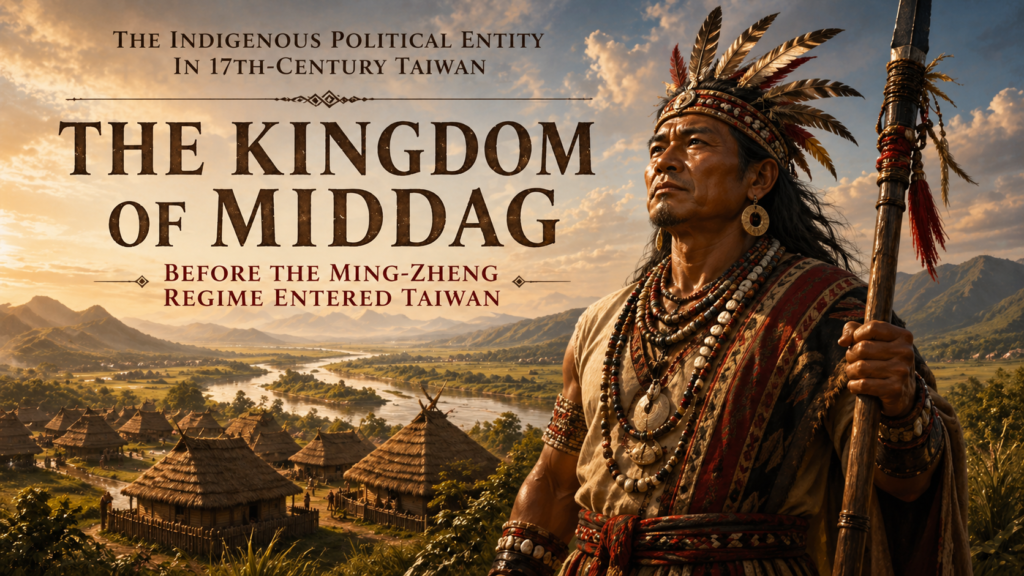
Before the Ming-Zheng regime entered Taiwan, a locally formed political entity already existed in central Taiwan.
It was the Kingdom of Middag, also known as the Dadu Kingdom.
Before examining the Kingdom of Middag in detail, one point must be made clear: the Kingdom of Middag was not the whole of Taiwanese Indigenous history.
It primarily represented a political alliance of Pingpu village communities in the central-western plains and inland areas of Taiwan during the seventeenth century. Other regions of Taiwan, including the north, the south, the east coast, the mountain regions, and the offshore islands, had their own Indigenous peoples, villages, ritual systems, land relations, and political orders.
Within the broader Austronesian context, the Kingdom of Middag was one western plains case that foreign records happened to document more clearly.
Taiwan, as one of the most important centers of Austronesian history, cannot be reduced to a single people, a single region, or a single political form. The western plains had Pingpu village alliances and kingdom-type political orders. The east coast and mountain regions also had their own tribal societies, ritual systems, land orders, and forms of intergroup alliance.
Taken together, these histories tell us something essential: before foreign regimes entered Taiwan, the island was not blank land. It was already inhabited, named, governed, ritually ordered, traveled, defended, remembered, and connected through alliances.
This article therefore does not present the Kingdom of Middag as the only or supreme representative of Indigenous political history in Taiwan. It uses the Kingdom of Middag as a concrete example to show that before foreign regimes arrived, Taiwan was not a land without owners, order, or history.
1. The Kingdom of Middag Was Not a Modern State, but It Was a Pre-Modern Political Entity
The standard must be clarified first.
The Kingdom of Middag was not a sovereign state in the modern sense of international law. It was not a nation-state in the way the term is understood today. It had no modern national flag, constitution, parliament, central bureaucracy, or membership in the present-day United Nations system.
However, when placed within the political standards of seventeenth-century East Asia, it can reasonably be understood as a kingdom-type political entity that emerged within Taiwan itself.
In the pre-modern world, a “state” was not the same thing as a United Nations member state.
The Ming and Qing dynasties of the seventeenth century belonged to a pre-modern imperial order. They were not modern nation-states.
Seventeenth-century Japan was a political order made up of the shogunate, daimyō, and domains. It was not a modern state either.
The Ryukyu Kingdom was also not a modern state, yet no one denies that it was once a kingdom.
So the real question is not:
“Was the Kingdom of Middag a modern state?”
The real question is:
“Under the historical standards of its own time, did it possess the characteristics of a pre-modern political community?”
The answer is yes.
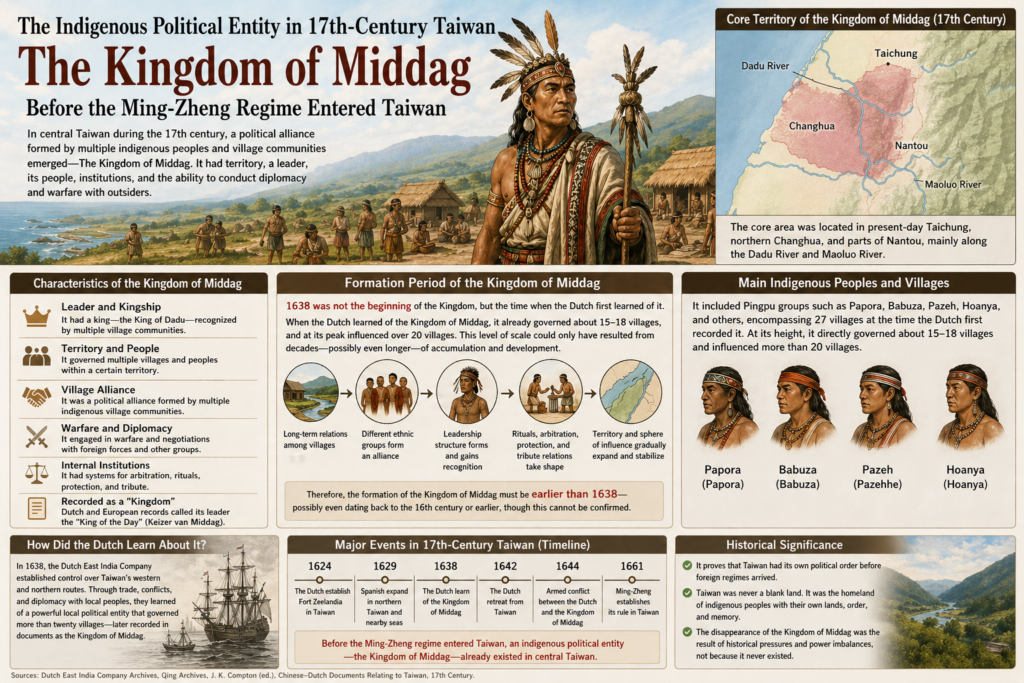
2. 1638 Was Not the Beginning, but the Moment Foreign Records Began to Notice It
The exact founding date of the Kingdom of Middag is difficult to determine today.
The clearest documented point comes from Dutch records: by 1638, the Dutch had already learned of the Kingdom of Middag’s existence.
But 1638 was not the beginning of the Kingdom of Middag. It was simply the point at which it began to appear in foreign records.
By that time, the kingdom already governed approximately fifteen to eighteen villages directly, and its influence reportedly reached more than twenty villages at its height. A political alliance of that scale could not have appeared overnight. It must have formed well before 1638, likely through decades or even longer of accumulation.
Whether its origins can be traced back to the sixteenth century remains a reasonable inference. The precise date should remain open.
This distinction matters.
It shows that the Kingdom of Middag was not a temporary local force assembled only after foreign regimes arrived. It was a political order that had developed over time within Taiwanese Indigenous society.
3. The Kingdom of Middag Was a Political Alliance of Central-Western Pingpu Groups
The core territory of the Kingdom of Middag was roughly located in present-day Taichung, northern Changhua, and parts of Nantou, mainly along the Dadu River and Maoluo River areas.
It was not a single tribe. It was a cross-village political alliance formed by multiple Indigenous communities, including the Papora, Babuza, Pazeh, Hoanya, and other Pingpu groups.
It had a leader: the King of Dadu.
It had territory.
It had affiliated villages and peoples.
It had village alliances.
It engaged in wars and negotiations with outside forces.
It had systems of arbitration, ritual, protection, and tributary relations.
It was also recorded by outsiders as a kingdom. In Dutch and European documents, the King of Dadu was called Keizer van Middag, often rendered as the King of Middag or the King of the Day.
These features show that the Kingdom of Middag was not an ordinary village. It was not a loose cluster of tribes without political order.
It was a kingdom-type political entity developed by Taiwan’s Indigenous societies.
That point, however, must not be overstated. The Kingdom of Middag primarily represented a political alliance of Pingpu groups in Taiwan’s central-western plains and inland areas. It cannot stand in for the entire history of Taiwan’s Indigenous peoples.
The east coast, mountain regions, south, north, and offshore islands all had different Indigenous peoples, social forms, language systems, ritual relations, land orders, and ways of interacting with outsiders. The social organization, environment, and historical experience of east-coast Indigenous peoples were not the same as those of the western plains groups.
The history of Taiwan’s Indigenous peoples and Austronesian peoples is broader, deeper, and older than the Kingdom of Middag. The importance of the Kingdom of Middag lies in the fact that it allows us to see one concrete form of Indigenous political organization: village alliance, leadership authority, land order, ritual relation, external negotiation, and military resistance.
In other words, the Kingdom of Middag was not the whole story. It was, however, powerful evidence against the idea that Taiwan had no political order before foreign regimes arrived.
4. Pre-Modern Political Order Did Not Have to Look Like a Modern State
The most important aspect of the Kingdom of Middag is not simply that it had a leader called a “king.” What matters more is the political logic behind it, a logic that allowed society to function at the time.
Modern states maintain authority through law, bureaucracy, military power, taxation, and clearly defined borders.
Pre-modern political entities often maintained order through kinship, locality, ritual, prestige, alliance, protection, and mutual recognition.
The authority of the King of Dadu belonged to this kind of pre-modern political order.
His authority did not come from modern legal commands. It did not come from a layered bureaucracy administering the population from above. It came from ritual, arbitration, protection, and spiritual leadership.
In that society, the King of Dadu was not only a political leader. He was also a spiritual leader who helped maintain order among the land, nature, ancestral spirits, and human communities.
This form of authority was different from that of a modern state.
But difference does not mean absence.
Many people mistake the lack of modern state institutions for the absence of state-like qualities.
That is incorrect.
The pre-modern world contained many different forms of states, kingdoms, chiefdoms, tribal alliances, and political communities.
Some were maintained by emperors and bureaucracies.
Some were maintained by religion and lineage.
Some were maintained by village alliances, ritual authority, and military cooperation.
The Kingdom of Middag belonged to this world.
It was not a local administrative unit of a Chinese dynasty.
It was not an order created by foreign regimes.
It was not blank land waiting to be “discovered” by colonizers.
It was a political order that grew from Taiwan’s own Indigenous ground.
5. The Dutch Faced Not Scattered Villages, but a Local Political Force
In the mid-seventeenth century, one of the better-documented Kings of Dadu was Camachat Aslamie, also known in Chinese as 甘仔轄・阿拉米.
He was not the only King of Dadu, but he is one of the figures more clearly traceable through Dutch-period records.
Between 1644 and 1645, the forces of the Kingdom of Middag came into armed conflict with the Dutch East India Company.
Dutch troops advanced northward along the western plains and attacked villages under Dadu influence that were hostile to the Company. Eventually, open armed conflict subsided, and the relationship between the Kingdom of Middag and the Dutch was forced to change.
This conflict is significant.
It shows that what the Dutch faced was not a set of scattered villages, but a local political force with governing capacity, resistance capability, and negotiating weight.
Had the Kingdom of Middag been merely an ordinary tribe, foreign powers would not have needed to deal with it in this way.
History shows that the Dutch had to face it.
That fact alone demonstrates that the Kingdom of Middag carried real political weight in central Taiwan at the time.
6. Ming-Zheng and the Qing Did Not Enter an Empty Land. They Rewrote an Existing Land Order
After the Ming-Zheng regime entered Taiwan, it also came into conflict with central Indigenous villages.
To obtain land, food, and space for military farming and settlement, Ming-Zheng inevitably collided with the land order and ethnic forces already present on the island.
In other words, Ming-Zheng did not enter a land without owners.
It entered a Taiwan that already had Indigenous societies, land relations, village alliances, and political authority.
For example, the 1670 conflict involving Shalu Village, according to later historical records, dealt a severe blow to the Kingdom of Middag and its related villages.
This was not an isolated conflict. It was part of a direct collision between an existing Indigenous land order and the military-settlement forces of an incoming regime.
Later, as Qing rule expanded, the central Pingpu groups again faced pressures from land encroachment, corvée labor, taxation, and Han immigration, culminating in what is known as the Dajiaxi She Incident.
From the Dutch to Ming-Zheng to the Qing, what the Kingdom of Middag and its related villages endured was not only military pressure. It was also the pressure of an entire land order being rewritten.
The disappearance of the Kingdom of Middag therefore does not mean it was unimportant.
Its later compression and dissolution cannot simply be treated as proof that it was “inherently weak.” Its political status cannot be denied merely because it was eventually defeated.
More accurately, it faced foreign powers with overwhelming advantages in military technology, population resources, supply capacity, administrative organization, and land systems.
The Kingdom of Middag relied largely on village alliances, knowledge of the terrain, bows and arrows, and traditional forms of defense.
Foreign regimes, by contrast, gradually brought firearms, cannons, organized armies, immigrant settlement, land registration, corvée taxation, and divide-and-rule strategies.
When hunting grounds became farmland, when villages were divided, and when the land order was rewritten, the political community originally sustained by ritual, arbitration, protection, and village recognition was gradually worn down.
The dissolution of the Kingdom of Middag therefore does not mean it had never been a political entity.
On the contrary, its conquest, compression, and forced migration show that it had been a local force foreign regimes had to confront.
7. The Kingdom Dissolved, but Its People Did Not Disappear
The dissolution of the kingdom did not mean the disappearance of its people.
The Kingdom of Middag as a political order was compressed, severely damaged, and eventually dissolved. Yet the peoples and villages connected to it did not vanish from Taiwanese history.
Some were forced to migrate. Some remained in place and became intertwined with later immigrant societies. Some gradually lost their original languages and names under long-term Sinicization and social pressure.
Yet their descendants, place names, ritual memories, and ethnic traces still remain in central Taiwan and the Puli area of Nantou.
The kingdom dissolved, but the people did not completely disappear.
The form of governance disappeared, but the memory of the land remained.
A political entity is conquered, compressed, and dissolved precisely because it once existed and once held power.
If it had not existed, there would have been no need to conquer it.
If it had carried no political weight, it would not have become something foreign regimes had to confront.
8. Reconsidering the Kingdom of Middag Does Not Mean Forcing It into the Mold of a Modern State
This is why we revisit the Kingdom of Middag today.
Not to force it into the mold of a modern sovereign state.
That would be inaccurate and unnecessary.
What we need to do is place it back within its own historical era.
Under the political standards of seventeenth-century East Asia, the Kingdom of Middag possessed the characteristics of a state-type political entity.
It had a leader, territory, ethnic and village alliances, external conflict and negotiation, internal order, ritual and spiritual authority, and a political status recognized by outsiders as that of a king.
These conditions are sufficient for us to say:
The Kingdom of Middag was indeed a kingdom-type political entity formed within Taiwan’s Indigenous world, and it existed before the Ming-Zheng regime entered Taiwan.
Conclusion: Taiwanese History Did Not Begin with Foreign Regimes
This history matters to Taiwanese people today.
It shows that Taiwanese history is not only a history of being colonized, ceded, received, and ruled.
Taiwan once had its own peoples.
Taiwan once had its own order.
Taiwan once had its own kingdom.
More importantly, it tells us that Taiwanese history did not begin with the footsteps of foreign regimes.
Taiwanese history began with the people of this land.
It began with the lives of the Indigenous peoples.
It began with villages, rivers, forests, rituals, land relations, and communities.
The Kingdom of Middag is one of the names in this history most worthy of being remembered again.
It was a seventeenth-century Indigenous political entity in central Taiwan, a kingdom-type political order that existed before the Ming-Zheng regime arrived.
So the next time someone says that Taiwan had no politics, no order, or no history of its own before foreign regimes arrived, we should remember at least one name:
The Kingdom of Middag.
The Kingdom of Middag reminds us of a simple truth:
Taiwanese history was never a blank page.
It is only one of the names now being seen again.
Beyond the central-western region of Taiwan, the east coast, mountain regions, south, north, and offshore islands still hold many more Indigenous peoples, villages, communities, forests, rivers, coasts, and land memories. Together, they form a deeper, earlier, and fuller Austronesian history of this island.
This land has always had its own peoples, its own order, and its own memory of itself.
© 2026 Falian Wanlin. All rights reserved.
Quotations are welcome with proper attribution and a source link. Unauthorized full reproduction or commercial use is prohibited.